FDM vs. SLS vs. SLA vs. MJF: Choosing the Right 3D Printing Technology
A practical guide to understanding the strengths and weaknesses of the four major 3D printing technologies.
Understanding the 3D Printing Landscape
3D printing, also known as additive manufacturing, has revolutionized product development and manufacturing. With a plethora of technologies available, selecting the right one for your specific needs can be daunting. GoMy3D offers four prominent technologies: Fused Deposition Modeling (FDM), Selective Laser Sintering (SLS), Stereolithography (SLA), and Multi Jet Fusion (MJF). Each boasts unique characteristics in terms of materials, accuracy, surface finish, and cost. This guide will provide a comparative overview to help you make an informed decision for your next project. Whether you’re a hobbyist, a small business, or a large enterprise, understanding these differences is crucial for optimizing your 3D printing outcomes.
The key to successful 3D printing lies in aligning your project requirements with the capabilities of the chosen technology. Considerations include the complexity of the design, the required material properties, the desired surface finish, and, of course, the budget. Let’s delve into each technology to understand how they stack up against each other.
FDM: Fast, Affordable, and Accessible
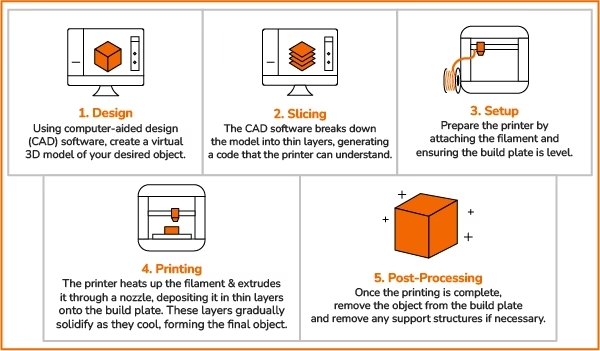
Fused Deposition Modeling (FDM) is the most widely accessible and cost-effective 3D printing technology. It works by extruding a thermoplastic filament through a heated nozzle, layer by layer, to build the part. FDM is ideal for rapid prototyping, creating simple parts, and educational purposes. Its affordability makes it perfect for beginners and hobbyists. The material selection is broad, encompassing common plastics like PLA, ABS, PETG, and more specialized materials like nylon and carbon fiber composites.
However, FDM has limitations. It typically produces parts with a lower dimensional accuracy and a rougher surface finish compared to other technologies. Layer lines are often visible, and intricate details may be challenging to achieve. Support structures are often required for overhanging features, which need to be removed post-printing. Despite these limitations, FDM remains a versatile and practical choice for many applications where cost and speed are paramount.
Consider FDM if you need quick prototypes, low-cost parts, or are experimenting with different designs. It’s a great entry point into the world of 3D printing.
SLS: Dimensional Accuracy and Chemical Resistance
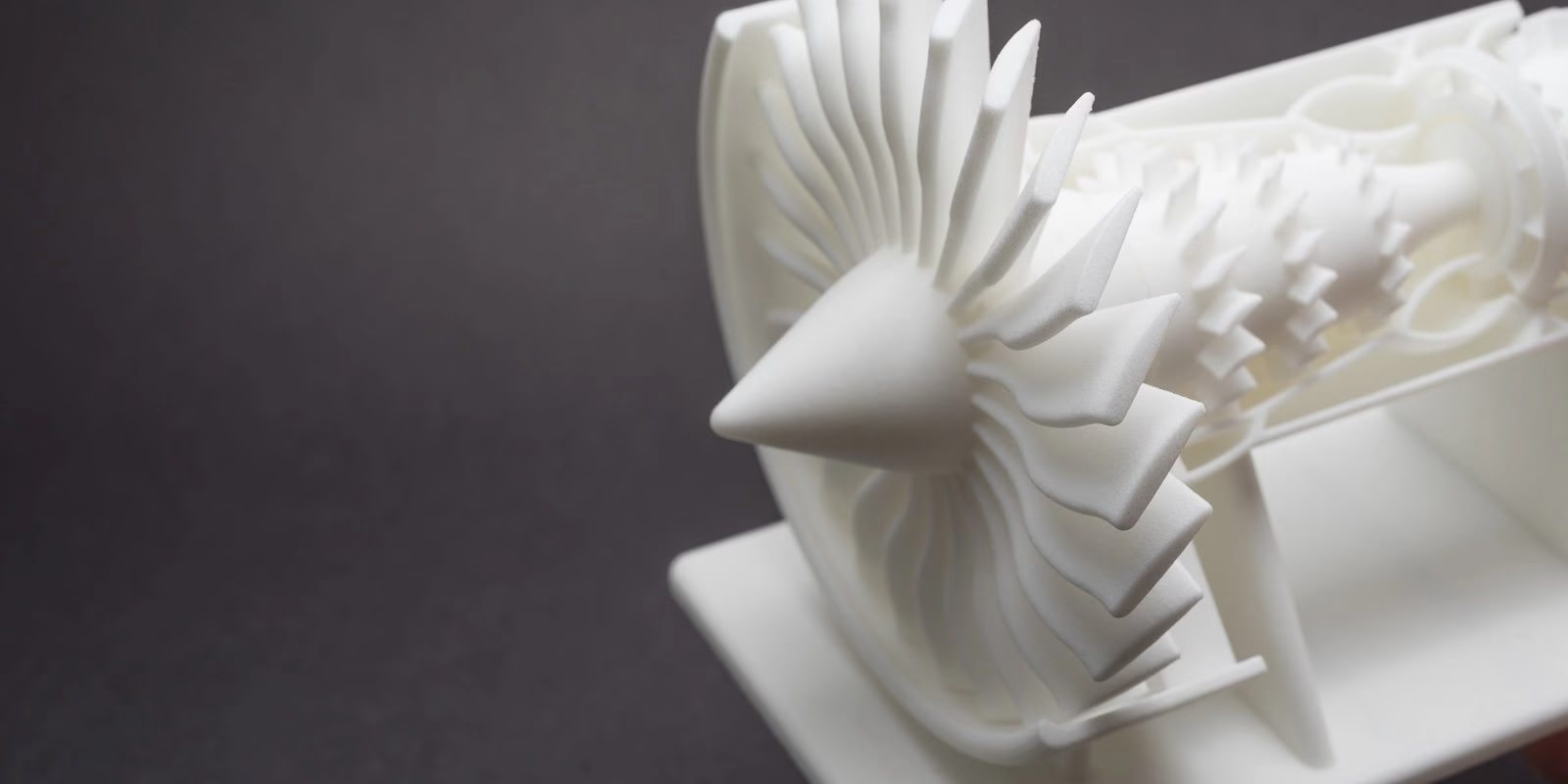
Selective Laser Sintering (SLS) utilizes a laser to fuse powdered material, typically nylon-based, layer by layer. This technology excels in producing parts with excellent dimensional accuracy and mechanical properties. SLS parts are known for their chemical resistance and durability, making them suitable for functional prototypes and end-use parts.
One of the key advantages of SLS is that it doesn’t require support structures. The unsintered powder surrounding the part provides support during the printing process, allowing for complex geometries and interlocking parts. This also reduces post-processing time and material waste. SLS parts often exhibit a slightly grainy surface finish, but this can be improved through post-processing techniques like bead blasting or dyeing.
SLS is a good choice when you need functional parts with good mechanical properties, complex geometries, and chemical resistance. It’s commonly used in industries such as aerospace, automotive, and medical device manufacturing.
SLA: Smooth Surfaces and High Strength
Stereolithography (SLA) uses a laser to cure liquid resin, layer by layer, creating parts with exceptionally smooth surfaces and high strength. SLA is ideal for applications requiring fine details, intricate designs, and a polished finish. It’s commonly used in jewelry design, dental modeling, and prototyping consumer products.
SLA parts often exhibit superior dimensional accuracy compared to FDM and SLS. The wide range of resins available allows for diverse material properties, including flexible, heat-resistant, and biocompatible options. However, SLA parts typically require support structures, which need to be removed post-printing. Some resins may also be sensitive to UV light and require post-curing to achieve optimal mechanical properties.
Choose SLA when surface finish, fine details, and high accuracy are critical. It’s a great option for creating visually appealing prototypes and functional parts with specific material properties.
MJF: Cost-Effective for Complex, Watertight Structures
Multi Jet Fusion (MJF) is a powder bed fusion technology that uses a fusing agent and a detailing agent to selectively fuse layers of nylon powder. MJF excels at producing cost-effective, watertight structures with complex geometries and consistent mechanical properties. It’s ideal for producing functional prototypes, end-use parts, and complex assemblies.
MJF parts are known for their isotropic properties, meaning they have similar strength in all directions. The technology also allows for high part density, making it suitable for batch production. MJF offers a good balance between cost, speed, and part quality. While the surface finish is not as smooth as SLA, it’s generally better than SLS and can be further improved through post-processing.
MJF is an excellent choice when you need robust, watertight parts with complex designs and consistent mechanical properties, especially in medium to high volumes. It’s widely used in industries like automotive, consumer goods, and industrial equipment.
Making the Right Choice: A Summary
Choosing the right 3D printing technology depends heavily on your specific project requirements. Here’s a quick summary to guide your decision:
- FDM: Best for fast, affordable prototypes and simple parts.
- SLS: Ideal for functional parts requiring good mechanical properties, chemical resistance, and complex geometries.
- SLA: Suited for applications where surface finish, fine details, and high accuracy are paramount.
- MJF: Excellent for cost-effective production of complex, watertight parts with consistent mechanical properties.
Consider factors such as material properties, dimensional accuracy, surface finish, production volume, and budget when making your selection. Consulting with 3D printing experts can also help you determine the optimal technology for your needs.
Key Takeaways
- FDM
- SLS
- SLA
- MJF
- 3D printing technologies
- 3D printing for beginners
- Rapid prototyping
- Manufacturing
- Additive manufacturing