FDM vs. SLA vs. SLS vs. MJF: A Product Engineer's Guide to 3D Printing
Choosing the right 3D printing technology is crucial for product engineers balancing performance, cost, and lead time.
Understanding the Landscape of 3D Printing Technologies
For product engineers, 3D printing offers unparalleled opportunities for rapid prototyping, tooling, and even end-use part production. However, navigating the diverse landscape of 3D printing technologies can be challenging. This guide compares four prominent methods: Fused Deposition Modeling (FDM), Stereolithography (SLA), Selective Laser Sintering (SLS), and Multi Jet Fusion (MJF), highlighting their strengths, weaknesses, and ideal applications. We’ll benchmark these technologies against the capabilities you can expect from a platform like SeekMake, focusing on material options, achievable tolerances, and cost considerations.
The selection of the right 3D printing process significantly impacts the final product’s quality, functionality, and cost-effectiveness. This decision must be made based on the specific requirements of your project, including material properties, dimensional accuracy, surface finish, and production volume. Let’s dive into the details to empower you to make informed decisions about your 3D printing needs.
Fused Deposition Modeling (FDM): The Workhorse
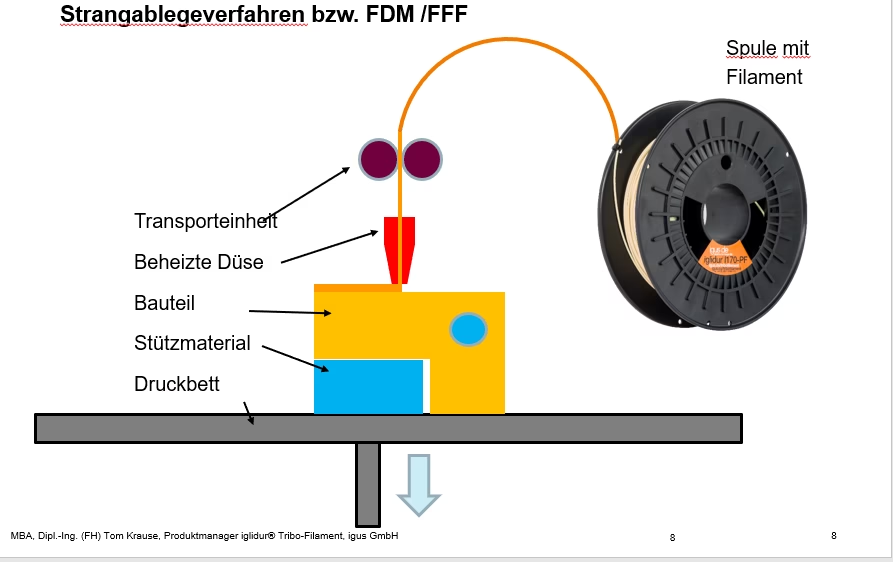
FDM, also known as Fused Filament Fabrication (FFF), is the most widely accessible 3D printing technology. It works by extruding a thermoplastic filament through a heated nozzle, layer by layer, to build a three-dimensional object. Advantages: FDM offers a wide range of readily available and affordable materials, including ABS, PLA, PETG, Nylon, and PC. It’s suitable for large parts and quick prototypes. Disadvantages: FDM typically has the lowest dimensional accuracy and surface finish compared to other methods. Layer lines are often visible, and fine details may be lost. Support structures are usually required, which can leave marks on the finished part.
Material Considerations: FDM excels with common thermoplastics. For engineering applications, consider materials like Nylon (for strength and flexibility) or PC (for high temperature resistance). However, complex geometries and fine features may be challenging. Tolerance Expectations: Expect tolerances in the range of +/- 0.2mm to 0.5mm, depending on the printer and material. Cost Tradeoffs: FDM is generally the most cost-effective 3D printing method, especially for larger parts and higher volumes. When compared to SeekMake’s automated quoting tools, FDM parts are often the cheapest option, making it ideal for initial design iterations and functional testing.
Stereolithography (SLA): Precision and Detail
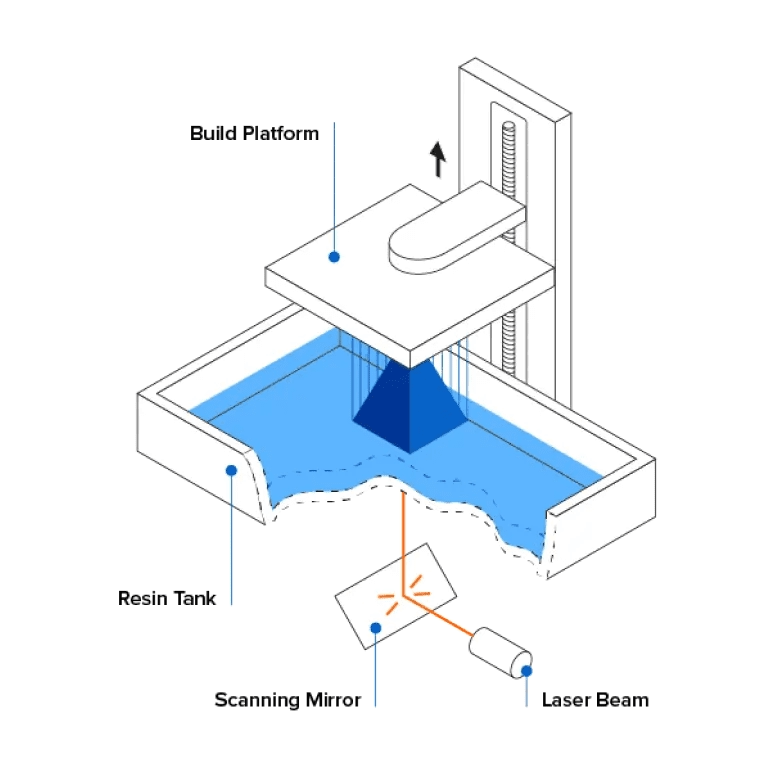
SLA uses a laser to cure liquid resin, layer by layer, into a hardened object. Advantages: SLA offers excellent dimensional accuracy and surface finish, making it suitable for intricate details and smooth surfaces. It’s often used for jewelry, dental models, and prototypes requiring high precision. Disadvantages: SLA materials are typically more brittle and less durable than FDM materials. The range of available resins is also more limited. Support structures are almost always required and can be more difficult to remove than FDM supports.
Material Considerations: SLA resins offer a range of properties, including flexible, tough, and heat-resistant options. However, they generally lack the strength and durability of engineering-grade thermoplastics. Tolerance Expectations: SLA can achieve tolerances in the range of +/- 0.05mm to 0.1mm, making it significantly more precise than FDM. Cost Tradeoffs: SLA is generally more expensive than FDM due to the higher cost of materials and equipment. However, the superior accuracy and surface finish can justify the increased cost for certain applications. SeekMake helps you compare SLA pricing across multiple vendors to find the best balance of quality and cost.
Selective Laser Sintering (SLS): Functional Strength and Complexity
SLS uses a laser to fuse powdered material, layer by layer, into a solid object. Advantages: SLS offers excellent mechanical properties and allows for the creation of complex geometries without the need for support structures (as the unsintered powder supports the part during printing). It’s commonly used for functional prototypes, end-use parts, and low-volume production. Disadvantages: SLS materials are typically limited to nylon-based powders, although other materials are becoming available. The surface finish can be slightly rough, and the parts may require post-processing.
Material Considerations: Nylon PA12 is the most common SLS material, offering good strength, durability, and chemical resistance. Other options include glass-filled nylon and flexible TPU. Tolerance Expectations: SLS can achieve tolerances in the range of +/- 0.1mm to 0.3mm. Cost Tradeoffs: SLS is generally more expensive than FDM and SLA due to the higher cost of materials and equipment. However, the ability to print complex geometries and functional parts without supports can make it a cost-effective option for certain applications. Using SeekMake, engineers can upload complex designs and get instant SLS quotes, factoring in part complexity and material selection automatically.
Multi Jet Fusion (MJF): Speed and Scalability
MJF uses an inkjet array to selectively apply fusing and detailing agents to a bed of powder, which is then fused by heating elements. Advantages: MJF offers excellent dimensional accuracy, surface finish, and mechanical properties. It’s also one of the fastest powder-bed fusion technologies, making it suitable for medium-volume production. Disadvantages: MJF materials are primarily limited to nylon-based powders, although HP continues to expand its material offerings. The initial investment in MJF equipment is relatively high.
Material Considerations: PA12 is the most common MJF material, offering similar properties to SLS nylon. HP also offers materials like PA11 (for ductility) and TPU (for flexibility). Tolerance Expectations: MJF can achieve tolerances in the range of +/- 0.08mm to 0.2mm. Cost Tradeoffs: MJF is generally more expensive than FDM, SLA, and SLS for very low volumes. However, its speed and scalability make it a cost-effective option for medium-volume production runs. With SeekMake, you can compare MJF quotes with other technologies to determine the optimal production method based on your specific volume requirements.
Making the Right Choice with SeekMake
Choosing the optimal 3D printing technology requires careful consideration of material properties, dimensional accuracy, surface finish, cost, and production volume. FDM is a cost-effective option for initial prototypes and large parts. SLA offers high precision and smooth surfaces. SLS enables the creation of complex geometries and functional parts. MJF provides a balance of speed, accuracy, and scalability for medium-volume production.
SeekMake’s platform simplifies this decision-making process by providing instant quotes and comparing capabilities across various 3D printing technologies and vendors. By uploading your 3D model to SeekMake, you can quickly assess the cost and lead time for each technology, allowing you to make an informed decision based on your specific requirements. Consider factors like material properties, tolerances, and surface finish to select the best technology for your project. SeekMake helps you navigate these complexities and optimize your 3D printing workflow.
Key Takeaways
- FDM vs SLA vs SLS
- Choose 3D printing technology
- 3D printing for engineers
- 3D printing materials
- 3D printing cost